
Sex Offender Checks in Pope County
The Illinois State Police Sex Offender Registry is the official public starting point. ISP says the database is updated daily. It can locate records tied to Pope County while also showing entries categorized as incarcerated or out of state. No official Pope County sheriff list, separate local map, or municipal registry was found. That makes the ISP search the documented public channel, while the registering law-enforcement agency remains the place to verify a local address or status.
Start with enough detail to separate similar names. A full first and last name helps, while date of birth, city, ZIP code, county, status, and offender type can narrow a broad result. A blank search result is not proof that a person has no criminal record. The registry covers only people and offenses that fall under Illinois registration laws. Court files, police reports, and other convictions remain in their own systems.
Pope County Registry Updates
ISP maintains the public database, but local agencies collect and verify registration information. Illinois law generally places that work with the police chief inside a municipality and the sheriff in unincorporated areas. A mailing address that says Golconda does not by itself settle which office has jurisdiction. Municipal boundaries, not the postal label alone, control that choice.
Photos are taken by the local registering agency and uploaded to the state record. Address, work, school, vehicle, and status changes depend on reports and agency processing. Read the displayed update and status fields, then contact the named registering agency if a current safety question turns on a precise location.
Note: A daily database update does not mean every field was independently verified that day.
How to Search the Illinois Registry
The ISP interface opens after the user reads and accepts its conditions. Search broadly first, then add filters only when the first result set is too large. For a countywide view, select Pope in the county dropdown. For a known person, ISP's own guide recommends beginning with first and last name. The result list provides a Details link to the public profile.
- Open the ISP disclaimer and read the limits on use before selecting Agree.
- Enter a first and last name, or select Pope County for a location-based search.
- Add date of birth, city, ZIP, status, homeless, or offender-type filters when needed.
- Open Details and compare identifiers, address jurisdiction, offense, and compliance fields.
| Field Label | Type | Required | Notes |
|---|---|---|---|
| First and Last Name | Text | Unspecified | ISP recommends starting with both names. |
| Date of Birth | Date/text | No | Useful for separating similar names. |
| City or ZIP Code | Text | No | May be combined with other fields. |
| County | Dropdown | No | Select Pope; the list also has incarcerated and out-of-state groups. |
| Status, Homeless, Offender Type | Dropdown/checkbox | No | These filters narrow the result set. |
The registry also provides an address map. Enter an address or click a location, then select a yellow marker to open details in the side pane. Map placement should be checked against the written profile because a marker is a visual aid, not a substitute for the registered address field.
Pope County Search Screens
The official ISP disclaimer screen states the conditions that govern access.
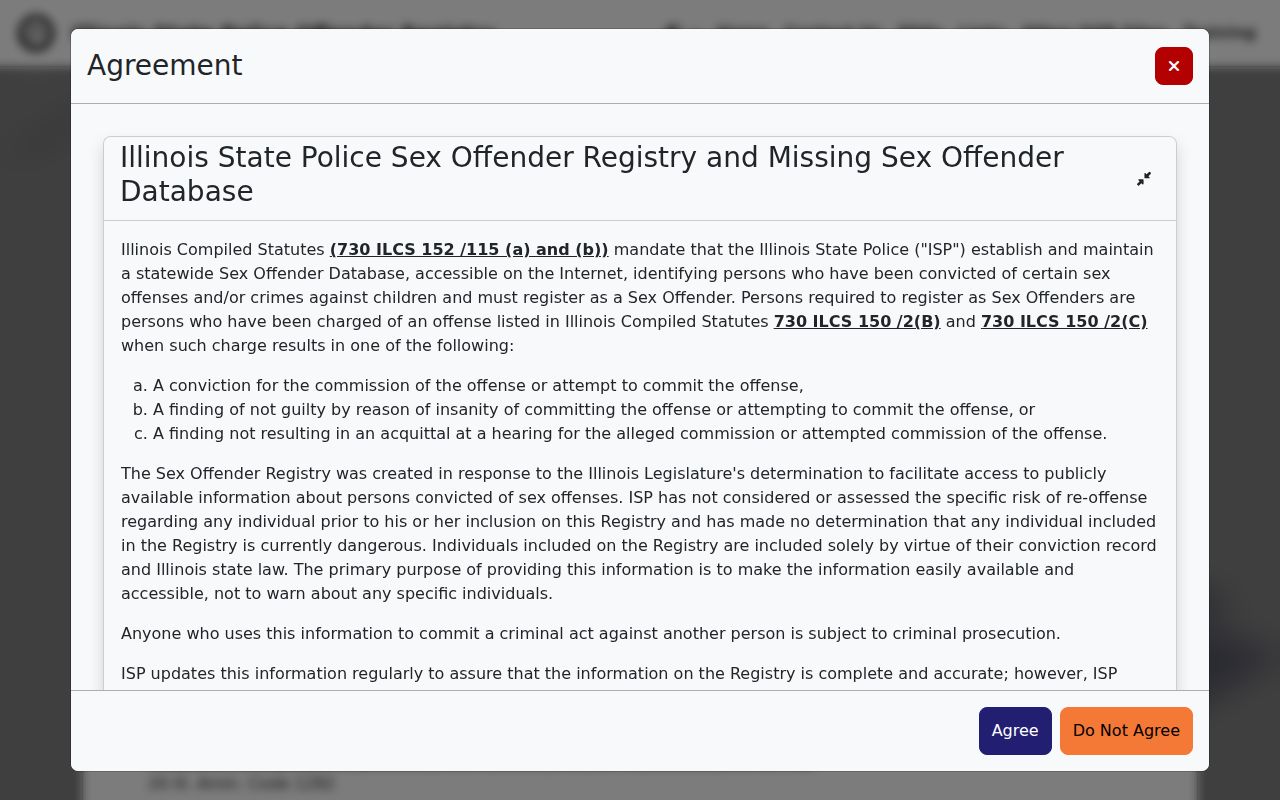
That screen matters because lawful use begins before a search is submitted.
The accepted ISP registry search interface displays the filters used for Pope County results.
Its field choices explain why a county filter and a name search can answer different questions.
Inside a Registry Profile
A public profile helps identify the correct person and understand the registration record. It can include identity, physical description, residence, registering jurisdiction, offense, and compliance information. The exact public fields depend on law and the data reported. Absence of a work, school, or vehicle field on a visible profile does not prove that the underlying agency has no such information.
| Name and Aliases | Published identity names used to match the record. |
|---|---|
| Photo and Description | Date of birth or age, sex, race, height, weight, hair, eyes, and identifying marks may appear. |
| Registered Address | Residence, city, ZIP, county, registering agency, homeless, incarcerated, or out-of-state status. |
| Offense and Statute | Offense description, citation, conviction date and place, and victim age category where authorized. |
| Classification | Offender category and registration duration or status when shown. |
| Compliance Status | The public status reported through the registering and state systems. |
Pope County Profile Limits
The profile is a statutory registry record, not a statewide rap sheet. It does not replace the Pope County Circuit Clerk's case file, which may hold the charging document, docket, judgment, and sentence. Nor does it replace the arresting agency's incident report. A registry offense label can be concise, while a court file may show several counts with different outcomes.
Readers should match several identifiers and verify consequential facts with the court or registering office. A single name match is not enough to establish identity.
Illinois Registration Levels and Requirements
Illinois does not use a simple public Tier I, II, and III chart that can safely be substituted for the statute. Duties vary by legal classification, offense, date, and current status. Many registrants report annually for ten years. Sexual predators generally register for life and report every 90 days. Persons defined as sexually dangerous or sexually violent also have lifetime duties, with the applicable verification rules controlled by current law.
| Level / Tier | Duration | Verification Frequency |
|---|---|---|
| Many registrants | Generally 10 years | Generally annual |
| Sexual predator | Lifetime | Every 90 days |
| Sexually dangerous or sexually violent classifications | Lifetime | Controlled by the applicable statute and status |
National Searches Beyond Pope County
The Dru Sjodin National Sex Offender Public Website adds a cross-state layer. It is useful when a person may have moved or when an address sits near a state line. NSOPW gathers public data from participating jurisdictions, while the Illinois profile remains the closer source for the state's displayed classification and registering details.
The national interface should not be treated as a second criminal-history database. Search results still depend on the public information supplied by each jurisdiction. When a national match points back to Illinois, open the state record and read the source details there.
The official NSOPW search page shows the national scope.
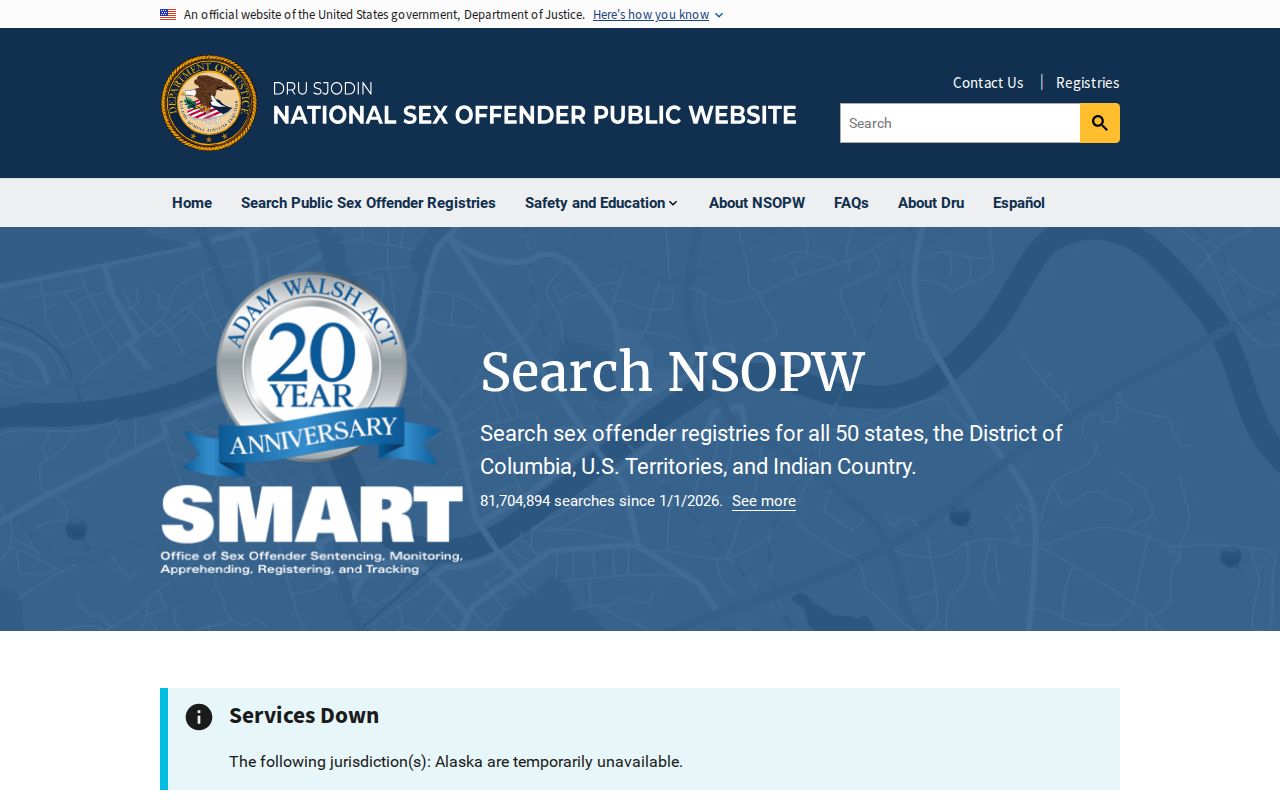
This cross-state view is most useful as a lead to the maintaining jurisdiction.
Pope County Address Restrictions
Illinois restrictions depend on the person's classification and conduct. Research identified statutory limits that can apply near schools, child-care facilities, playgrounds, youth programs, and other protected places, but those rules should not be reduced to one universal distance statement for every registrant. A map pin alone cannot decide whether a particular address violates the law.
For a real compliance concern, note the displayed address, registering agency, and profile status. Report it to the law-enforcement agency with jurisdiction. Do not confront the person or publish accusations. Agency staff can compare the current classification, location, and legal restrictions.
Community Notification and Lawful Use
Registry information supports community awareness and practical safety planning. It can help a family review nearby published addresses, understand a disclosed offense category, or identify the agency responsible for registration. It does not authorize private enforcement. If a Pope County record appears wrong or a person may be noncompliant, give the information to law enforcement and let the agency investigate.
Misuse is prohibited: ISP warns that using registry information to harass or threaten a registrant or household may violate criminal law. See 730 ILCS 150 and 730 ILCS 152.
Keep the result in context. Registration shows a present legal duty tied to a qualifying matter. It does not supply every fact in the criminal case, and it does not transfer authority from police or courts to members of the public.